Why the Cheapest Patio Quote Is Missing Scope
When one patio quote comes in far below the others, the gap is usually a shorter scope list, not a better deal. Check the three gaps that most often go missing before you compare totals.
By PatioBoQ · Updated · Methodology & limits
When three contractors visit your property to measure the exact same backyard, look at the same access gate, and listen to the same goals, you expect their bids to reflect roughly the same job. When one patio quote arrives significantly below the others, the instinct is to believe that contractor found a faster technique, runs leaner overhead, or buys materials in heavier volume. In practice, genuine efficiency differences rarely account for wide spreads between bids. When a quote sits far below its peers, the explanation is almost always simpler: it contains a shorter list of work.
Low Price, Short List
Every construction quote is a math equation where the bottom line equals the sum of the rows above it. If an estimator removes three tasks from the worksheet, the total drops immediately. That does not mean the tasks are unnecessary; it simply means they have not been accounted for on paper. When comparing bids, homeowners naturally focus on the final number at the bottom of the page because it represents the cash outlay. However, that number only covers what is explicitly written in the scope of work.
Leaving items off a proposal is not inherently an act of bad faith. In the residential landscape and hardscape trades, many experienced builders operate with informal habits developed over decades. An owner-operator who has built patios for twenty years might write "install 280 sq ft paver patio" on an invoice pad because, to them, that shorthand mentally includes digging, hauling dirt, compacting stone, and cleaning up the yard. Another contractor down the street might use the exact same shorthand phrase to mean placing pavers over whatever existing subgrade happens to be there, leaving hauling and lawn restoration as separate tasks to be billed if requested.
Because both proposals use sparse wording, they look identical to an untrained eye while representing two entirely different scopes of labor and equipment. When an estimate lacks detail, you cannot tell whether the contractor intends to perform the task as an unbilled courtesy, skip the step entirely, or hand you a supplemental bill once your lawn is torn up. That ambiguity is why missing rows must be systematically clarified rather than assumed.
The Three Gaps We Check First
When evaluating hardscape proposals, certain project elements disappear from paperwork far more frequently than others. Paver units themselves, sand, and visible surface accessories almost always appear because someone has to buy them from a dealer. The elements that vanish are typically site work, structural retention, and water management.
To illustrate how physical realities translate to paper omissions, consider a standard rectangular paver patio measuring 20 × 14 ft (280 sq ft). Using standard construction baselines—a 150 mm (6 in) compacted aggregate base, a 25 mm (1 in) screeded bedding layer, and standard paver thickness—we can quantify exactly what physical work this structure requires.
Excavation Spoils and Soil Disposal
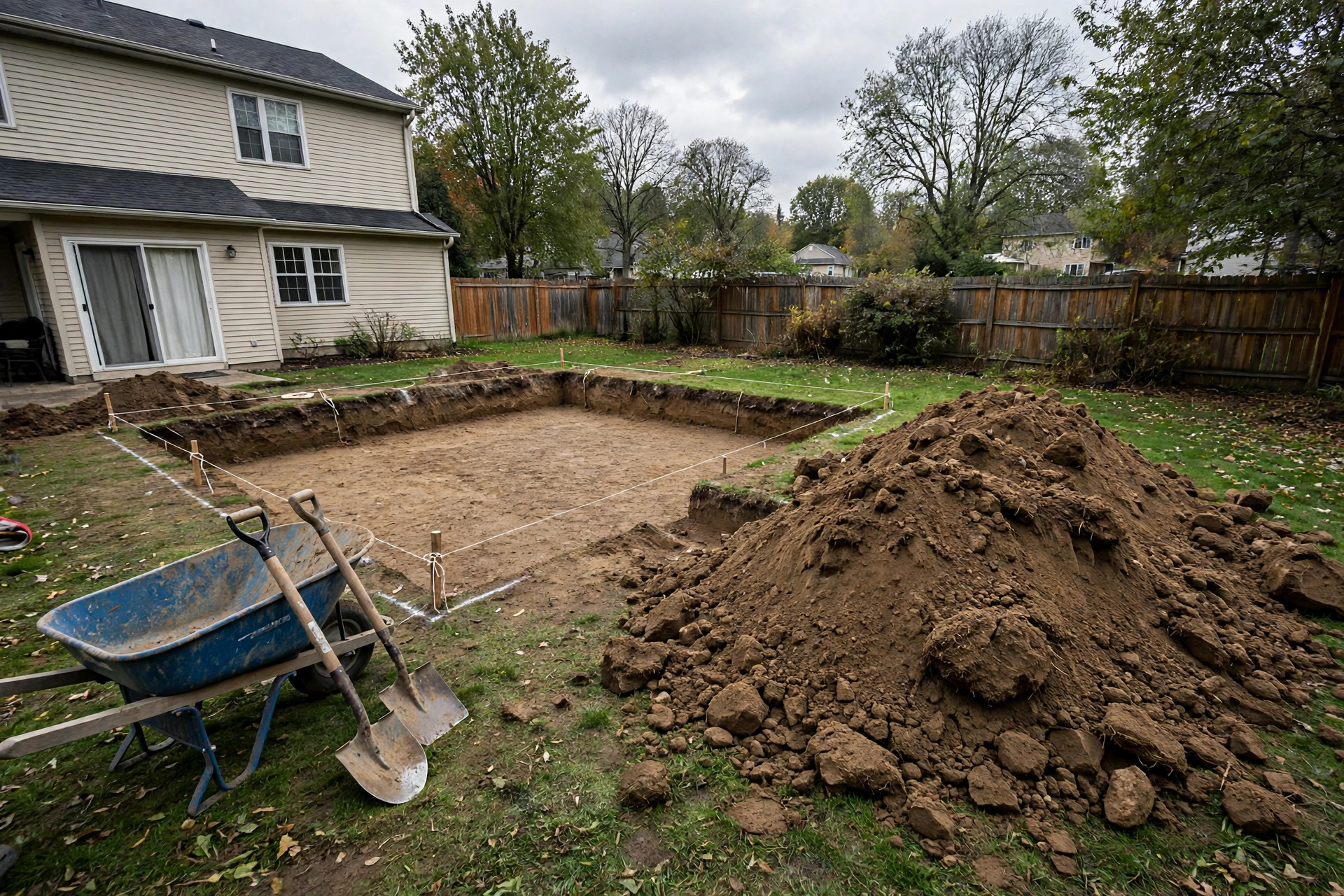
Before a single shovel of crushed stone enters a backyard, existing turf and native soil must come out. For a 20 × 14 ft patio built to standard residential depth, digging this patio produces about 8.0 yd³ of soil in the ground, which swells to about 10.0 yd³ loose once excavated.
Ten cubic yards of loose dirt is not a pile that disappears behind a garden shed. It represents roughly a full tandem-axle dump truck load or multiple trips with a heavy-duty disposal trailer. Hauling that volume offsite requires equipment time, driver hours, vehicle fuel, and commercial tipping fees at a regional disposal facility or soil recycler.
When a proposal mentions excavation but never explicitly lists soil removal, offsite hauling, or disposal fees, that volume of dirt still exists. In many instances, contractors who omit disposal plan to disperse the spoils across low spots in your existing lawn, mound it into peripheral planting beds, or leave it piled at the edge of the property line. If you assumed the contractor would take the dirt away, you may face an unexpected conversation halfway through the excavation phase, followed by an additional charge to bring in a disposal truck.
Perimeter Edge Restraints
Paver installations are flexible pavement systems. Unlike poured concrete, which cures into a monolithic slab, individual concrete pavers rely on interlock—the friction generated by joint sand and horizontal compaction—to carry pedestrian and furniture loads. That interlock only functions if the outside perimeter is firmly locked in place. Without lateral restraint, walking on the patio causes the edge pavers to drift outward into the turf, opening the joints, allowing joint sand to wash out, and destabilizing the field.
A 20 × 14 ft patio has 68 ft of perimeter. Securing that perimeter requires 68 linear feet of continuous edge restraints, anchored deep into the aggregate base with heavy steel spikes or set into a dedicated fiber-reinforced concrete edge beam troweled below grade.
When a bid lists square footage and surface pavers but remains completely silent on edge restraints, it is silent on a primary structural component. Installing edge restraints requires dedicated hardware, excavation beyond the paver boundary to support the restraint base, and labor to anchor and backfill the perimeter. Leaving restraints off the estimate lowers the bid on paper, but skipping them in the ground means the edges of your patio will begin migrating into the grass within a few seasons of rain and foot traffic.
Drainage Path and Finished Slope
Water is the single greatest threat to hardscape longevity. Rainfall must flow off the paver surface and away from building foundations, basement walls, and neighboring boundaries. To accomplish this, the subgrade, the aggregate base, and the finished paver surface must be graded with a consistent slope—typically between 1% and 2%, or roughly a quarter-inch of drop per linear foot of run.
Nothing in a lump-sum price tells you which way the finished surface sheds water. An unstated slope is an unpriced decision made later by default. If a contractor plans to simply mirror the existing grade of your yard without correcting swales or installing collection points, they save substantial grading labor and transit setup time. However, if your yard pitches toward your home foundation or forms a natural basin during storms, ignoring drainage during the quoting phase makes water pooling on the pavers or moisture pushing against your house more likely. Adding catch basins, channel drains, perforated pipe, or extensive regrading after construction begins requires significant change orders that erase any upfront paper advantage.
Scope note: The quantities and measurements cited above reflect baseline estimating assumptions for calculation purposes (150 mm compacted base, 25 mm bedding layer, uniform rectangular boundary) and should not be construed as an engineered, site-specific structural design.
How to Test a Low Quote in Ten Minutes
Evaluating whether an appealing proposal is a legitimate value or an incomplete list does not require an engineering degree or hours of phone calls. You can systematically verify any bid by following a structured four-step review:
- Audit against the full task list. Lay the bid alongside a comprehensive checklist of essential hardscape phases. Compare the written lines against the 16 line items that define a complete patio build, spanning site prep, subgrade compaction, geotextile separation, base depth, bedding materials, joint stabilization, edge retention, disposal, and site remediation.
- Mark every item as stated or not stated. Read the quote literally. If a line item mentions "spread crushed gravel" but does not specify compaction with a mechanical plate tamper or state the compacted depth, mark base thickness as not stated. If it lists digging but does not mention haul-off, mark disposal as not stated. Do not give the document credit for tasks that you discussed verbally in your garden but that never made it into the text.
- Send the unstated items as written questions. Email the contractor a calm, direct list of the missing points. Keep the tone collaborative rather than skeptical. For example: "Could you confirm whether the total includes offsite hauling for all excavated soil, the type of edge restraint system planned for the 68 feet of exposed perimeter, and the planned slope direction away from the rear foundation?"
- Compare totals only after answers arrive in writing. Set the proposal aside until the contractor responds. If they confirm that all unstated items are included in their original figure, ask them to update the scope description on the document. If they reply that disposal, restraints, or site grading require an added charge, incorporate those specific additions into their proposal before deciding which contractor represents the most competitive bid.
Cheap Can Be Fine — When the Scope Matches
The goal of reviewing quotes is not to force you into selecting the highest bid or to argue that premium pricing automatically means flawless craft. Some contractors genuinely carry lower overhead, operate smaller and highly efficient crews, maintain favorable local supplier relationships, or want to fill a specific gap in their installation calendar. In those scenarios, a lower total can be a genuine, honest advantage for the homeowner.
A lower bid is an excellent choice when the underlying scope matches the competing proposals item for item. The risk lies entirely in assuming that two different prices buy the exact same outcome when the documents themselves describe different amounts of work. By identifying gaps before work begins, asking targeted questions, and confirming every structural layer in writing, you ensure that you choose a contractor based on verified scope rather than the illusion of an incomplete list.