7 Questions to Ask Before You Sign a Patio Contract
Most patio disputes trace back to details both sides assumed and nobody wrote down. Seven straightforward questions, asked before you sign, turn unspoken expectations into writing.
By PatioBoQ · Updated · Methodology & limits
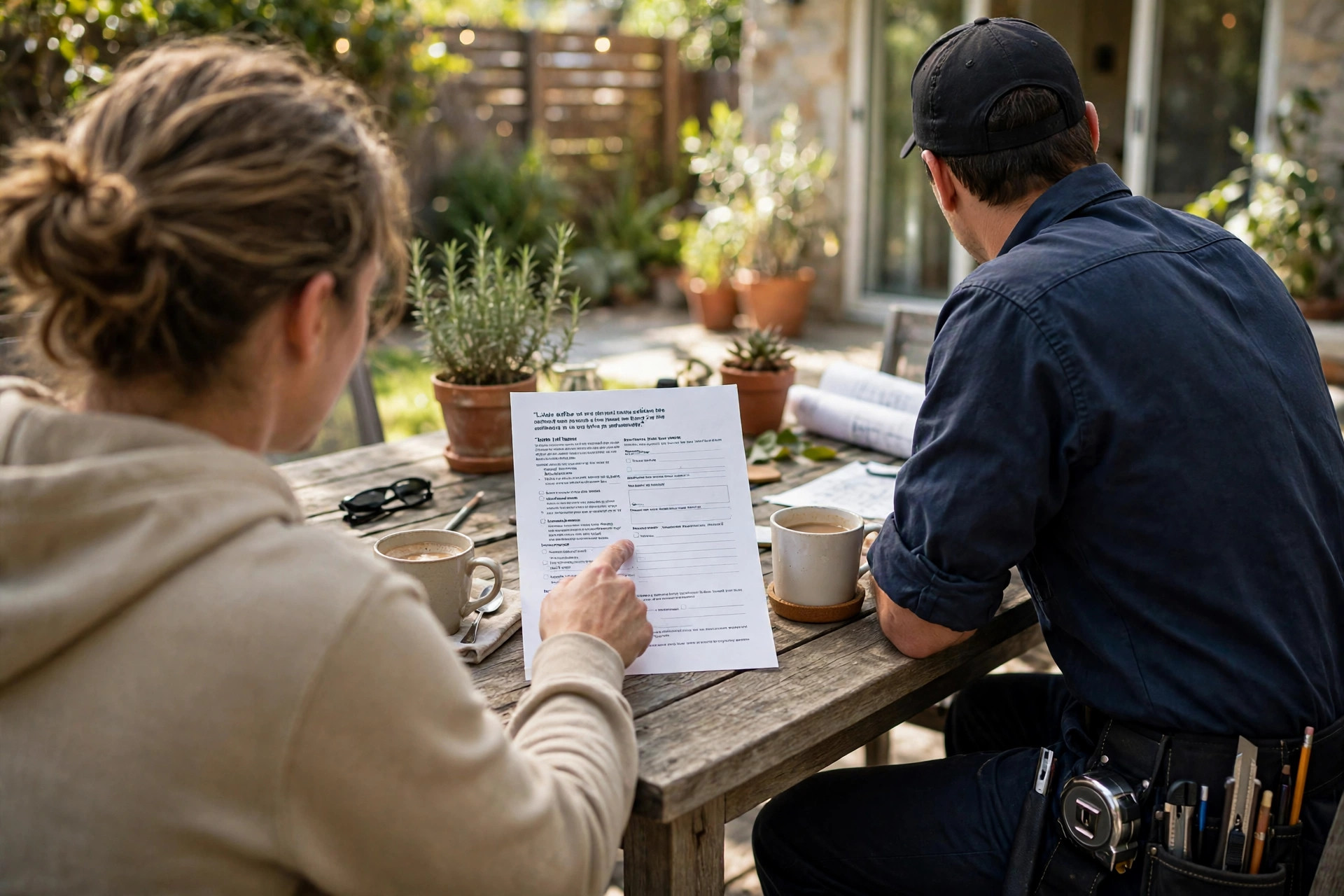
Most patio disputes rarely start with bad intentions or poor craftsmanship. More often, they trace back to unexamined assumptions—details both the homeowner and the contractor took for granted, yet nobody wrote down. A clear conversation before work begins prevents weeks of frustration later, turning unspoken expectations into writing so everyone shares the exact same definition of a finished job. Before committing to a patio contract, take the time to run through these seven straightforward points. These are practical questions, not legal advice.
The Seven Questions
1. What exactly is included—and excluded?
What to ask: Ask for an itemized scope of work specifying every task included in the price, alongside an explicit list of exclusions.
Why it matters: The phrase "complete patio installation" can mean very different things to different people. Homeowners often envision finished edges tied smoothly into the surrounding turf, steps reset, and irrigation adjusted. A contractor may consider the job finished once pavers are laid and swept with sand, leaving grading and lawn repairs as separate work. If a detail is not in writing, neither side can fairly hold the other accountable for it.
What a good answer looks like in writing: A written line-item scope detailing each distinct phase: site clearing, excavation, base installation, edge restraints, paver placement, and joint stabilization. Crucially, it should include a clear exclusions section, such as: "Excludes sod replacement, sprinkler head relocation, low-voltage lighting, and fence post repair."
2. How deep is the excavation, and what compacted base depth does the price assume?
What to ask: Ask for the planned excavation depth, the thickness of the compacted aggregate base, the type of gravel specified, and the bedding layer depth.
Why it matters: The long-term durability of any paver patio lives entirely below ground. A surface that looks flawless on day one can quickly sink, rut, or hold water if the crushed stone foundation beneath it is too shallow for local soil and frost conditions. Because digging deeper and hauling additional tons of stone requires extra labor and trucking, sparse quotes often cut corners right here where you cannot see it.
What a good answer looks like in writing: Specific, measurable dimensions rather than vague phrasing like "standard base." Look for language like: "Excavate native soil to a depth of eight inches below finished grade; supply, grade, and mechanically compact six inches of crushed gravel base in two-inch lifts; screed one inch of washed concrete bedding sand prior to paver placement."
3. Where does the excavated soil and debris go, and is disposal in the price?
What to ask: Clarify whether the removal, hauling, and off-site disposal of native soil, old sod, and job debris are fully covered in the quote.
Why it matters: Digging out a patio footprint produces tons of heavy earth and roots. Homeowners are often surprised to discover that "excavation" does not automatically include "haul-away." If disposal is omitted from the agreement, you may find a massive pile of clay left in your yard or receive an unexpected mid-job change order simply to truck the debris away to an approved disposal facility.
What a good answer looks like in writing: A clear statement confirming the handling of all spoils: "Price includes complete on-site removal, truck loading, transport, and off-site disposal fees for all excavated soil, sod, and project debris. No spoils will remain on the property." If clean fill is to be spread elsewhere on the lot for grading, the exact location should be agreed upon in the text.
4. How will water drain—what slope, and away from what?
What to ask: Ask how the finished surface will be pitched, what slope ratio is planned, and where surface runoff will travel during heavy rainfall.
Why it matters: Hardscapes transform absorbent lawn into an impervious surface. If a patio is installed completely level or pitched toward the house, rainwater will channel directly against your foundation walls or basement. Even away from the home, poor drainage planning can create standing surface puddles, wash out adjoining plant beds, or funnel water toward a neighbor's property line, creating lasting headaches.
What a good answer looks like in writing: Clear directional slope specifications: "Patio surface will be pitched away from the home foundation at a consistent minimum slope of one inch per eight feet of horizontal run, directing runoff toward the side yard swale." If the project requires channel drains, French drains, or buried downspout extensions, their collection points and termination zones should be listed explicitly.
5. What are the payment milestones, and what triggers each payment?
What to ask: Request a written payment schedule tied directly to observable stages of project completion rather than arbitrary calendar dates.
Why it matters: A balanced payment structure maintains mutual accountability. When a contractor asks for a disproportionate amount upfront or requests milestone payments based on calendar intervals rather than physical progress, homeowners lose their primary leverage if work slows down, materials fail to arrive, or questions arise about base preparation.
What a good answer looks like in writing: Installments linked to clear physical milestones: a modest deposit upon signing to secure calendar scheduling, a second payment upon material delivery and excavation completion, a third payment once the aggregate base is fully installed and compacted, and a final balance held until all punch-list items are finished and a final walk-through is complete.
6. What warranty covers the installation work, for how long, and what does it exclude?
What to ask: Ask for written terms separating the manufacturer's product warranty from the contractor's workmanship warranty.
Why it matters: A manufacturer's material warranty, if one applies, covers the product itself only—not installation settlement. It does not cover settlement, shifted edge restraints, or uneven stones caused by poor base compaction. Without a defined workmanship warranty, repairs needed after the first hard winter freeze will fall entirely on you.
What a good answer looks like in writing: A standalone workmanship clause: "Contractor warrants all installation workmanship, including base stability, edge restraint integrity, and settlement exceeding one-quarter inch, for a period of two years from the date of final completion." The text should clearly note exclusions, such as unapproved vehicle traffic on pedestrian-rated pavers or extraordinary acts of nature.
7. Who handles permits, utility marking, and site restoration if the lawn or access route is damaged?
What to ask: Confirm who secures necessary building permits, who calls the utility locating service before digging, and what repairs will be made to access paths and turf.
Why it matters: Heavy machinery like skid steers and mini-excavators will traverse your lawn repeatedly. Ruts, compacted soil, and broken sprinkler lines are common side effects of construction. Additionally, digging without utility locates risks severed power cables or municipal penalties. Without clear ground rules, homeowners often face surprise repair expenses just to return their yard to a clean, usable condition.
What a good answer looks like in writing: Clear operational terms: "Contractor will contact the local utility locate service prior to excavation and verify markings. Contractor is responsible for securing any required municipal permits. Contractor will install protective ground protection mats along the access path and will regrade, topsoil, and grass-seed all lawn areas rutted or damaged by machinery during construction."
How to Ask Them
Bringing up these details does not need to feel uncomfortable or adversarial. Experienced, professional hardscape contractors address these factors every day and generally appreciate working with homeowners who care about doing the job right. The simplest and most practical method is to compile your questions into a single, polite email shortly after receiving the initial proposal. Putting the conversation in an email thread ensures both sides have a written record to reference whenever needed.
Timing matters just as much as tone: ask these questions before signing an agreement and well before any machinery arrives at your curb. Resolving base depths, soil haul-away, or turf repairs during the middle of construction places unnecessary pressure on everyone involved. Approaching the contractor early gives you valuable insight into their working style. A builder who replies promptly and transparently in writing is showing you firsthand how they will communicate, solve problems, and manage your project from start to finish.
What If the Answers Stay Vague?
If a contractor brushes past your questions with general assurances like "don't worry, we do this all the time" or declines to provide specific numbers for base depths and milestone triggers, treat that response as helpful data. Ambiguity is rarely an accident; it usually indicates that the company prefers informal arrangements, does not operate with standardized contracts, or wants the freedom to adjust methods on the fly.
When answers remain unclear, you have straightforward choices. You can reply once more, asking politely for the missing points to be summarized in a simple written addendum before you commit. If the details are still missing, you can take that as a sign to collect another quote from a builder accustomed to providing detailed specifications. Or, you can choose to move forward with the current contractor, fully understanding where the unwritten assumptions lie. The choice is entirely yours based on your schedule, comfort level, and budget priorities. Asking the questions early simply ensures you make that decision with complete clarity.