Polymeric Sand vs Regular Joint Sand: What Your Patio Quote Should Say
The joints between pavers look like a finishing detail, but the material swept into them is a real line item — and many quotes say nothing about it at all.
By PatioBoQ · Updated · Methodology & limits
When homeowners evaluate a contractor estimate for a paver patio, attention naturally gravitates toward paver dimensions, stone textures, and excavation depth. The spaces between the individual units often look like a minor cosmetic detail — something swept into place during the final hour of work. In practice, the jointing material is a functional structural component and an operational labor step. Whether an agreement calls for standard unbonded sand or polymeric sand, omitting the exact product specification leaves room for differing expectations regarding durability, weather conditions, cleanup standards, and ongoing maintenance.
What Jointing Material Does
The joints in a segmental pavement system serve three primary physical functions: cushioning contact, promoting interlock, and shedding surface water.
First, individual concrete or clay pavers are rigid units placed closely together on a prepared bedding layer. Without an appropriate jointing aggregate, slight ground movements, thermal expansion, or foot traffic would cause paver edges to grind directly against one another. This direct contact causes edge spalling, chipping, and premature surface wear. The aggregate serves as a resilient spacer that absorbs and distributes localized horizontal stresses.
Second, the joint material contributes to aggregate interlock. When fine sand fills the vertical gaps and is properly compacted, friction develops between the sand particles and the vertical sidewalls of the paving units. As loads pass over the surface, this friction distributes the downward force across multiple neighboring pavers rather than allowing a single unit to depress into the setting bed.
Third, jointing material acts as a first line of defense against surface erosion. While conventional paver joints are not completely impermeable, a densely packed joint moderates how water enters the pavement system. Unfilled or eroded joints allow runoff to enter the bedding sand layer unchecked, which can lead to bedding washouts, shifting pavers, and uneven settling. Jointing material also minimizes the accumulation of windborne organic debris, reducing the open pockets where moss and airborne seeds can take root.
The Two Materials, Plainly
Contractors generally specify one of two primary jointing materials for residential paver patios: regular joint sand or polymer-modified sand. Each material has distinct physical traits and operational demands.
Regular Joint Sand
Regular joint sand consists of plain, washed, kiln-dried silica or masonry sand that has been screened to a uniform, fine gradation. It contains no chemical binders or adhesive additives.
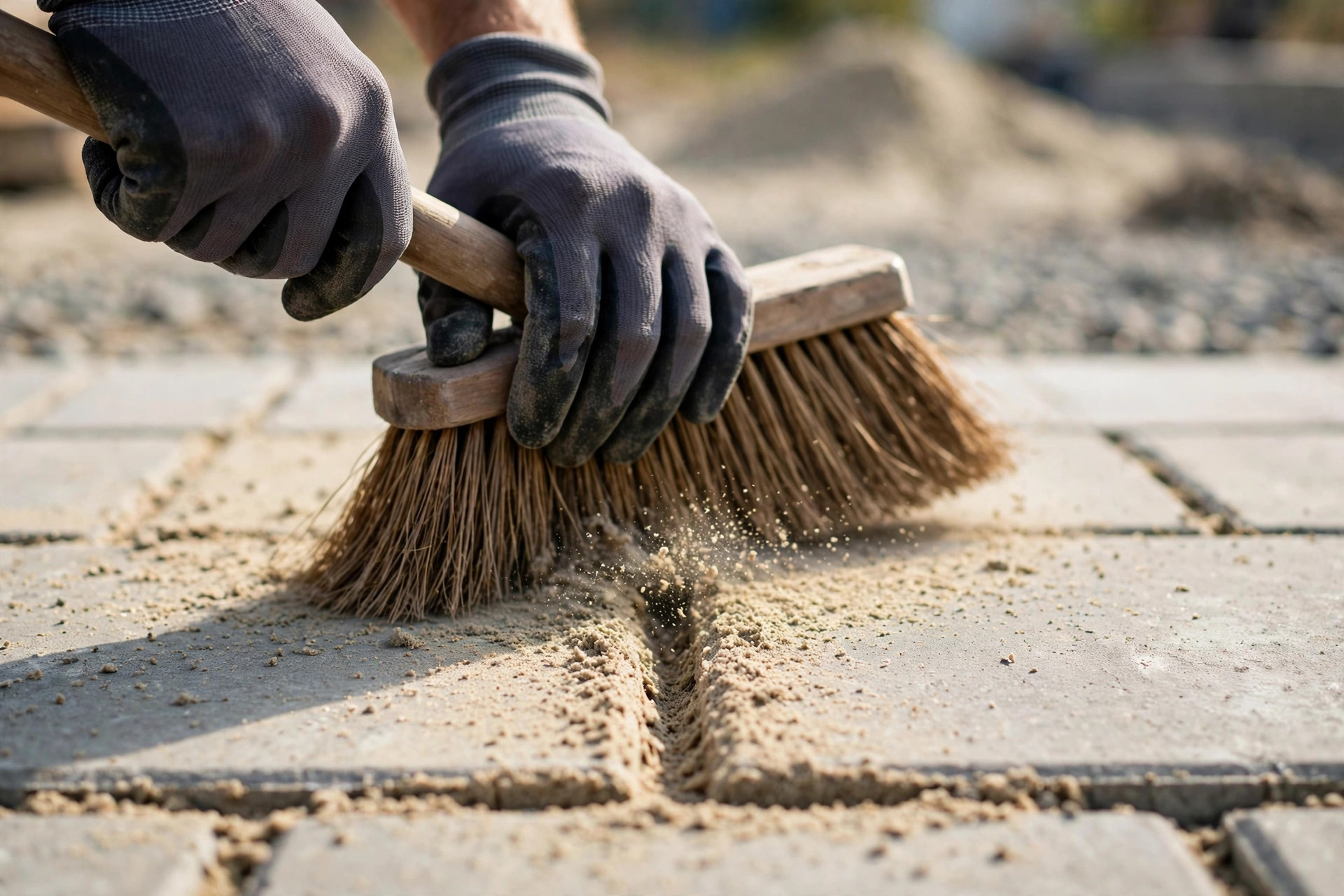
During installation, the contractor spreads the dry sand across the installed pavers and works it into the joints using a push broom, followed by mechanical compaction with a plate compactor to eliminate subterranean voids. Additional sand is swept in until the joints are filled to the bottom of the paver chamfers.
Because it contains no binding agents, regular joint sand remains loose and flexible. Water passes through it readily, and the individual grains can shift. Over time, regular sand will naturally erode from the joints due to rainfall runoff, mechanical cleaning, wind, and leaf blowers. It also allows burrowing insects like ants to dislodge grains. Maintaining a patio with regular sand requires periodic top-ups: homeowners or contractors must occasionally sweep fresh dry sand into the gaps to maintain the aggregate interlock.
Regular sand requires no curing process, carries virtually no risk of staining or hazing the paver faces, and can be applied in variable weather conditions as long as the aggregate and surface are reasonably dry.
Polymeric Sand
Polymeric sand is a factory-formulated blend of graded sand combined with chemical binders, typically fine polymers and organic or synthetic resins.
Like regular sand, it is swept into the joints dry and compacted to achieve full joint density. Once all excess sand and surface dust are completely removed from the paver faces, the material is activated by applying a controlled fine mist of water according to the manufacturer’s instructions. The water activates the binders, initiating a curing reaction. As the compound dries and cures, it hardens into an elastomeric matrix that holds the sand grains firmly in place.
Once fully cured, polymeric sand provides significantly higher resistance to surface washout, erosion, and dislodgement from garden equipment or insect activity. However, because it relies on a chemical curing process, the installation margin for error is narrow:
- The paver surface and joints must be completely dry prior to installation. Any residual surface moisture will cause the polymer to activate prematurely on the top face of the paver rather than deep inside the joint.
- The contractor must thoroughly blow or sweep every trace of polymer dust off the paver chamfers and surface textures before applying water.
- Watering must follow strict protocols — usually a series of light showers rather than a heavy hose stream — so the water penetrates the entire joint depth without rinsing the polymer binders out of the top layer.
- If water is applied over residual sand dust on the paver faces, it can cure into a cloudy, white film known as polymeric haze, which requires specialized chemical cleaners or mechanical stripping to remove.
Neither material is universally superior; each represents a different balance between initial installation precision and long-term joint maintenance.
What a Clear Quote States
A professional patio quote should leave no ambiguity regarding the materials being placed in your outdoor living space. In PatioBoQ’s published sample report, jointing material is one of the 16 items reviewers check when evaluating whether a contractor quote provides adequate technical clarity. When an estimate lists only a generic term like “sand” or “sweep joints,” it represents an unverified scope item that obscures both labor procedures and product expectations.
An unambiguous contractor estimate will clearly document the following items:
- Specific Product Category: The document should state explicitly whether the quote includes unbonded kiln-dried sand or a polymer-modified jointing compound, rather than relying on informal verbal assurances.
- Color Designation: Jointing sands are produced in multiple tones — typically shades ranging from light tan to slate gray — to coordinate with the selected paver palette. A clear quote lists the intended color or notes that the color selection is subject to homeowner approval.
- Application and Activation Standard: For polymer-modified products, the quote should explicitly state that application, compaction, and moisture activation will be performed strictly in accordance with the product manufacturer’s technical data sheet.
- Surface Cleaning and Haze Responsibility: The agreement should define surface protection standards, establishing that the installer is responsible for delivering a clean, haze-free paver surface upon completion of the joint activation.
- Post-Installation Follow-Up: The written scope should specify whether the contractor includes a return visit to inspect the joints and perform any necessary top-up after the initial curing window and first rain cycle.
Five Questions to Ask Before You Sign
Before approving an agreement or placing a deposit, ask the contractor to answer these five questions in writing:
Which specific jointing material is specified in this agreement, and is it regular dry sand or a polymer-bonded compound?
If a polymer product is used, what specific steps does your crew take to remove sand residue and prevent polymeric haze from adhering to the paver faces?
What weather conditions or moisture thresholds will cause your crew to pause joint installation to prevent premature activation or washouts?
Does the proposal include a return inspection to top up any low joints that settle after the initial compaction and watering cycles?
If joint erosion or settling occurs within the workmanship warranty period, who is responsible for providing the material and performing the remedial labor?
The Material Matters Less Than the Writing
Both regular joint sand and polymer-modified sand are legitimate construction materials that have delivered dependable results on residential patios for decades. Homeowners choosing traditional clay brick on a permeable bedding system may intentionally select unbonded sand for its historic aesthetic and effortless re-sweeping. Homeowners seeking high wash resistance against roof runoff or sloped drainage paths may reasonably prefer the cohesion of a cured polymer matrix.
Neither material can compensate for an inadequate crushed-stone subbase, a missing geotextile fabric, or poorly anchored edge restraints. Pavements fail from the bottom up, not from the joint down.
The primary risk on an estimate is not whether the contractor selects one aggregate technology over the other, but whether the contract fails to record the decision entirely. An unstated jointing material represents an unpriced operational assumption. When a quote clearly defines the product type, application method, and surface completion criteria in writing, both parties share the same benchmark for what constitutes a finished, quality installation.